


Rummy is a classic Indian card game of sequences and sets, and PH365 offers it with five betting rooms and quick 20-second turns. This guide covers the deck, the rules, the points formula, special mechanics and every room level, so you can take a seat and play with confidence.
What is Rummy?
Rummy is a skill-based card game where you race to arrange your hand into valid groups before your opponents do. The profile below covers the essentials.
- Origin: a traditional Indian card game, played today on tables of two to five people.
- Core goal: arrange all 13 cards into valid sequences and sets, then declare before anyone else.
- Skill factor: memory, probability and discipline matter more than a single lucky draw.
- Pace: each action has a 20-second timer, so decisions must be quick but not careless.
- Stakes: every room uses a per-point value, which makes the possible loss easy to calculate in advance.
- Availability: PH365 hosts the game across five levels, from a small starter room to a high-stake table.
Rummy deck and table setup
The game prepares the deck, deals the cards and picks a wild rank before the first turn. The setup is identical in every room.
Cards and number of players
The game combines two standard decks of playing cards with four Jokers. A table seats between two and five players, and each player is dealt 13 cards. The cards that remain form the closed deck, which players draw from during the hand. Because several decks are in play, duplicate cards are possible. That makes sets and sequences easier to complete than in a single-deck game.
Opening card and the printed joker
One card is flipped to start the open deck. A second card is then flipped at random to determine the Printed Joker, which acts as a wild card for that hand. If a Joker is flipped instead, every Ace acts as the Printed Joker. Check this wild card before you plan your hand, because it decides which cards are worth keeping. Players on PH365 should make this their first habit at every table.
Basic Rummy rules and turn flow
Turns follow a simple pick-and-discard rhythm controlled by a timer. These are the core rules every player needs.
- Starting player: one player is selected at random, and the rest play clockwise.
- Pick: on your turn, take one card from either the closed deck or the open deck.
- Discard: after picking, discard one card to the open deck so your hand returns to 13 cards.
- Timer: you have 20 seconds to pick and another 20 seconds to discard.
- Missed pick: if time runs out before you pick, one card is drawn automatically from the closed deck.
- Missed discard: if you picked but did not discard, the newly picked card is discarded automatically.
- Auto declaration: if all 13 cards are already in valid sequences and sets when time ends, a valid declaration is made for you.
- Connection: keep a stable connection on PH365, because the timers keep running even when your screen lags.
How to declare and build a valid Rummy hand
Winning requires a correctly arranged hand and a timely declaration. The requirements are strict, so each group type deserves a closer look.
Pure sequence and impure sequence
A pure sequence is three or more consecutive cards of the same suit without any Joker. It is known as the 1st Life, and every valid hand must contain one. A printed joker may be used as its original rank and suit while the sequence stays pure. An impure sequence also uses consecutive cards of one suit, but Jokers may fill the gaps. A valid hand needs at least one pure sequence and one impure sequence, and the impure one is commonly called the 2nd Life.
Sets and group size
The remaining cards must form further sequences of three or more cards, or valid sets. A set is normally three or four cards of the same rank in different suits. There is no maximum number of cards in a group, as long as the sequence requirements are met. This lets you extend a long run instead of splitting it unnecessarily.
Making the declaration
When all 13 cards are arranged, select your unwanted card and choose Declare instead of Discard. The first player to make a valid declaration wins the hand. Before you press Declare on PH365, confirm that your pure sequence holds no Jokers and that every card belongs to a group. If both the open and closed decks run out, hands are calculated instantly and the player with the lowest points wins. Everyone except the winner then calculates their points, and the reward is based on points multiplied by the bet amount.
Rummy points calculation and payout table
Points decide how much each losing player pays when a hand ends. The table summarizes card values and the main point penalties.
| Item | Points | Notes |
|---|---|---|
| Ace, King, Queen, Jack | 10 each | Counted only when outside every valid group |
| Number cards 2 to 10 | Face value | Same counting rule |
| Joker | 0 | Never adds to your total |
| Printed Joker | 0 | Wild rank set at the start of each hand |
| First drop | 20 points lost | Drop before picking a card |
| Middle drop | 40 points lost | Drop after picking a card |
| Missed declaration | 2 points lost | Actual deduction depends on the base bet |
| Maximum deduction | 80 | Cap on points deducted per hand |
Once you hold a Pure Sequence, only the cards outside every sequence and set are counted. The in-game formula is Rewards = (Total Losses Points × Per Point) × 0.95, so the 0.95 multiplier suggests that 5% of the pooled losses is held back. A simple Rummy example shows the math. At Level 3, with 2 per point, three opponents finishing on 25, 40 and 80 points produce 145 points. That equals 290 before the multiplier and 275.5 after it. Use this estimate on PH365 before joining a room.
Special Rummy mechanics and rules
A few features shape strategy more than the basic pick-and-discard loop. Keep these in mind before you sit down.
- Wild Aces: when a Joker is flipped to set the Printed Joker, all Aces act as the Printed Joker.
- Printed joker in pure sequences: it may stand for its original rank and suit and still keep the sequence pure.
- Unlimited group size: sequences can grow as long as they follow the sequence rules.
- Deck exhaustion: if both decks are empty, hands are scored instantly and the lowest total wins.
- Missed declaration penalty: if you miss your chance and another player declares validly, you lose 2 points, with the final deduction tied to the base bet.
- Deduction cap: no more than 80 points can be deducted from a player in one hand.
- Reward multiplier: the 0.95 factor is part of every reward calculation.
- Visible stakes: PH365 shows the per-point value and minimum entry on every room card before you join.
Drop and leave table rules in Rummy
A drop lets you step out of a weak hand at a fixed cost. The penalty depends on when you drop.
First drop and middle drop
A first drop happens before you pick any card and costs 20 points. A middle drop happens after you have already picked a card in that hand and costs 40 points. Both options exist for hands that are clearly unfavorable. Compared with the 80-point cap, a first drop is one quarter of the worst case and a middle drop is one half. That makes an early drop a calculated choice rather than a surrender.
Leaving the table
If you leave and nobody declares, the result depends on your progress. No card picked counts as a first drop, while a picked card counts as a middle drop. If another player declares before your next turn, your points are calculated from your current hand instead. Think twice before leaving a PH365 table mid-hand, because timing changes the penalty.
Rummy rooms and betting levels
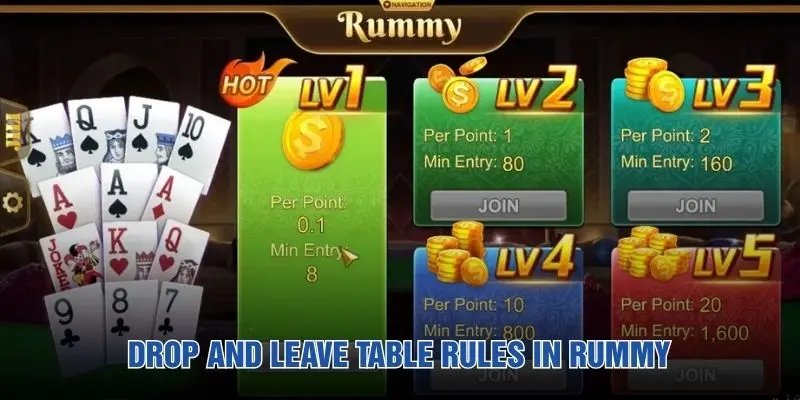
Five rooms cover small and large stakes, each defined by a per-point value. In every room, the minimum entry equals 80 times the per-point value, which matches the 80-point deduction cap.
| Level | Per point | Minimum entry | Maximum loss per hand | Room profile |
|---|---|---|---|---|
| Level 1 (Hot) | 0.1 | 8 | 8 | Low-stake starter room |
| Level 2 | 1 | 80 | 80 | Casual regular play |
| Level 3 | 2 | 160 | 160 | Moderate stakes |
| Level 4 | 10 | 800 | 800 | High stakes for experienced players |
| Level 5 | 20 | 1,600 | 1,600 | Highest stakes available |
Level 1 carries the Hot label and starts at an entry of 8, so it suits newcomers learning the timers and scoring. New Rummy players should stay there until they can build a pure sequence consistently. Choose a PH365 room by bankroll, not by confidence. The same 10-point loss costs 1 at Level 1, 10 at Level 2, 20 at Level 3, 100 at Level 4 and 200 at Level 5. The maximum loss column assumes the full 80-point deduction.
A typical hand from deal to payout
A walkthrough of one full hand shows how the rules connect, from the first card dealt to the final settlement. The example uses a Level 2 table, where each point is worth 1.
- Deal: one player is chosen at random to start, and play moves clockwise. Everyone receives 13 cards, one card is flipped to start the open deck, and another is flipped to set the Printed Joker. If that card is a Joker, all Aces become the Printed Joker.
- Decision: before drawing, check how many cards are connected and whether you hold any Jokers. If the hand is scattered, a first drop ends it immediately at a cost of 20 points. Once you pick a card, dropping costs 40 instead.
- Build: on each turn you have 20 seconds to pick from the closed or open deck and 20 seconds to discard. Aim for a pure sequence first, then a second sequence, then sets. Keep the hand at 13 cards after every discard.
- Declare: once all 13 cards sit in valid groups, select the spare card and choose Declare instead of Discard. The first valid declaration wins the hand. If you miss the chance and an opponent declares, you lose 2 points, scaled to the base bet.
- Score: each opponent counts only the cards left outside valid groups. Aces, Kings, Queens and Jacks are worth 10, number cards are worth face value, and Jokers are worth 0. No player can lose more than 80 points in one hand.
- Settle: total losing points are multiplied by the room’s per-point value, then by 0.95. For example, two opponents with 25 and 40 points give 65 × 1 × 0.95 = 61.75 at Level 2.
Practical Rummy tips for better results
Good habits beat lucky draws over the long run. These tips cover how to build stronger hands, cut your point losses and manage your bankroll at every table.
- Build the pure sequence first: it is mandatory for a valid hand, and no Joker can replace it, apart from a printed joker used as its original rank and suit. Look for three or more consecutive cards of one suit in your opening 13, and keep drawing toward that run before you chase anything else.
- Track the open deck: every discard shows what opponents do not need, and every pick shows what they are collecting. If a player keeps taking Hearts, avoid throwing away Hearts that could help them finish a sequence.
- Release high cards early: Aces, Kings, Queens and Jacks cost 10 points each when left outside a group, so a few stuck face cards can add 30 or 40 points to your loss. Discard unconnected high cards in the first few turns and keep low cards that may still join a run.
- Save Jokers for the second sequence and sets: Jokers carry 0 points and fill gaps, so they are most valuable in the impure sequence and in sets. Using one to rescue a weak group early often leaves you short when you need it most.
- Respect the clock: you have 20 seconds to pick and another 20 to discard, and a missed pick or discard is made automatically. Practice sorting by suit and rank, and decide which card you will throw before your turn arrives.
- Drop with a plan: if your opening hand has scattered cards, no near-complete run and no Jokers, a first drop costs only 20 points. A middle drop costs 40, so it is worth it only when your picks have not improved the hand and opponents are close to declaring.
- Match the room to your budget: start at a low level on PH365, where the minimum entry is 8 at Level 1, and learn the timers and scoring there. Move up only when your balance can cover several full-penalty hands, since a maximum 80-point loss at Level 2 is already 80.
Conclusion
Rummy rewards players who build a pure sequence early, watch the open deck and respect the clock. With five levels, clear per-point stakes and well-defined drop rules, PH365 gives you a structured way to enjoy the game. Start low, learn the scoring and always play within your own limits.
